
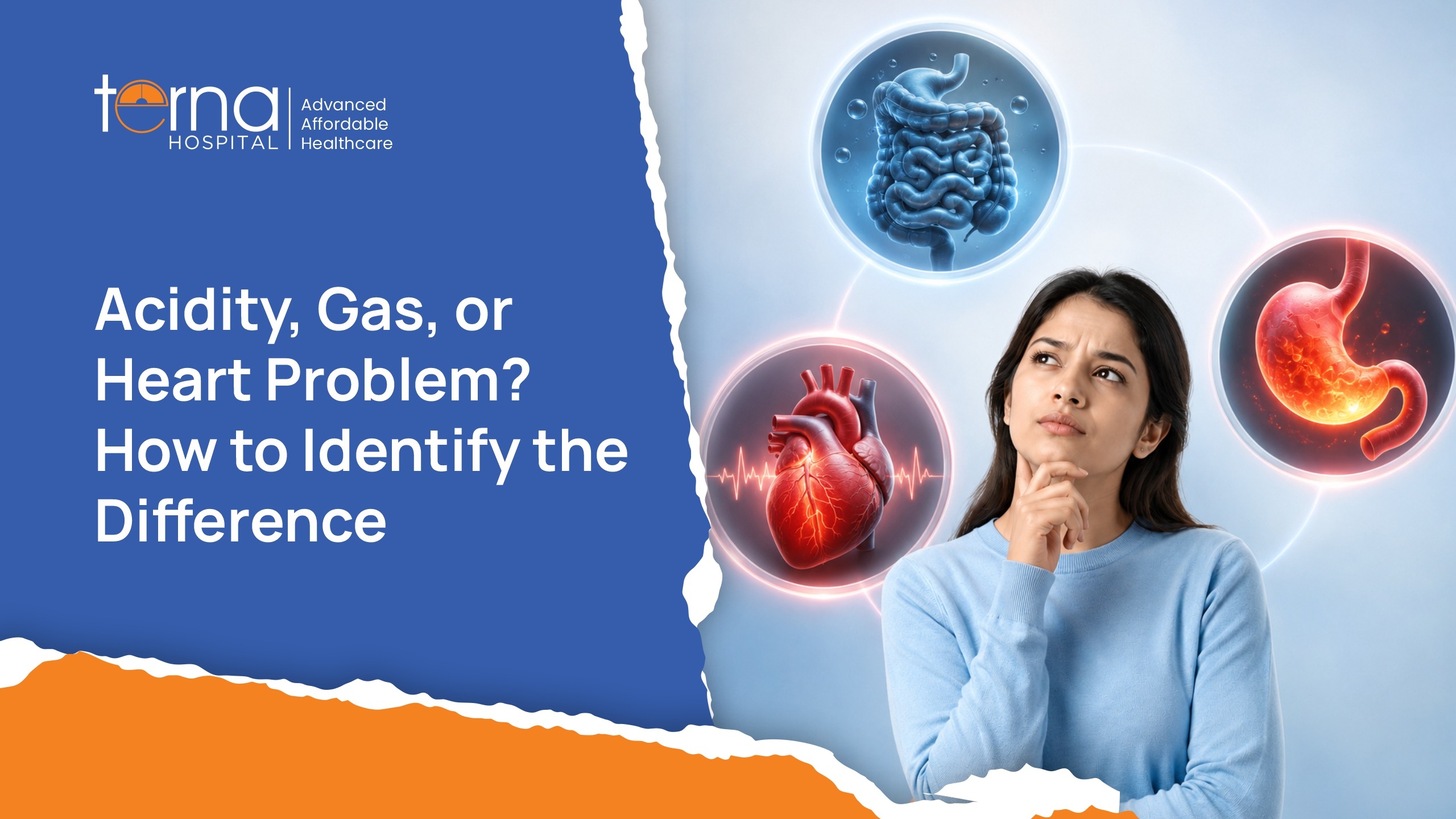
Imagine you’ve just finished dinner, and a few minutes later you feel a burning sensation in your chest. Your first thought might be, “It’s probably acidity.” But then another question pops into your mind: “Could this be a heart problem?”
Many people have experienced this confusion at least once. While chest discomfort is often caused by acidity or gas, it can also be an early sign of a heart attack. Knowing the difference is important because the right decision at the right time could protect your health, or even save a life.
Acidity and heart-related chest pain can show up in the same general area, feel like burning or tightness, and arrive after a meal or during stress. But they are caused by two very different things, and telling them apart, even roughly, can help you decide faster what to do next. This article walks through how each one typically feels, the red flags that should never be brushed aside, and what to do when you genuinely can’t tell.
One thing to say clearly before anything else: if you are ever unsure whether chest pain is acidity or a heart attack, treat it as a medical emergency and get checked immediately. It is always safer to be evaluated and told it was gas than to assume it was gas and be wrong.
Why Acidity and Heart Pain Get Confused So Often
Both conditions can involve discomfort in the center or left side of the chest. Both can cause a burning sensation. Both can happen after eating, and both can occur during moments of stress or exertion. The nerves that carry pain signals from the stomach, esophagus, and heart are also closely connected, which is part of why the brain sometimes struggles to pinpoint exactly where a pain signal is coming from.
Add to this the fact that heart attacks don’t always look like the dramatic, clutch-your-chest scene shown in movies. Some present as a dull ache, pressure, or heaviness that can genuinely resemble indigestion. This overlap is exactly why doctors take any new or unusual chest discomfort seriously rather than assuming it’s minor.
What Acidity or Gas-Related Chest Pain Usually Feels Like
Doctors usually look at several factors, including where the pain is, how long it lasts, what triggers it, and whether it’s associated with symptoms such as sweating or breathlessness, to understand whether chest pain is more likely caused by acidity or a heart problem. Walking through your own symptoms with that same reasoning can help you get a clearer picture too.
Start by thinking about what happened before the pain started. Did you just eat a heavy meal, spicy food, or drink a lot of tea or coffee? Did you lie down soon after eating? If yes, acidity could well be the cause.
Acidity related chest pain usually shows up as a burning sensation that starts in the upper stomach and rises toward the chest or throat, sometimes described as heartburn. There’s often an accompanying sour or bitter taste in the mouth, along with belching or a bloated feeling in the stomach. Importantly, this kind of discomfort tends to ease up, at least partially, after taking an antacid or after some time has passed, and it doesn’t usually come with sweating, breathlessness, or pain spreading to the arm or jaw.
Many people also notice that chest discomfort improves after burping, passing gas, or walking around for a few minutes. While this may suggest gas or indigestion, it doesn’t completely rule out a heart problem, so it’s still worth paying attention if the discomfort returns or new symptoms appear.
What Heart-Related Chest Pain Usually Feels Like
Heart-related chest pain, sometimes called angina (a type of chest pain caused by reduced blood flow to the heart), tends to behave differently, though it can sometimes be subtle enough to be missed.
It’s commonly felt as pressure, tightness, squeezing, or heaviness in the chest rather than a sharp or burning pain, and it may spread to the left arm, shoulder, jaw, neck, or back. It often comes on with physical exertion, emotional stress, or even at rest, and it doesn’t reliably improve with antacids or resting alone. Many people also notice breathlessness, cold sweats, nausea, lightheadedness, or an unusual sense of fatigue alongside the chest discomfort.
Imagine climbing a flight of stairs or carrying heavy shopping bags. If you develop chest pressure, shortness of breath, or pain spreading to your left arm during activities like these, don’t assume it’s acidity. Discomfort that shows up specifically with physical effort, and eases when you stop, is one of the clearer signals that it could be heart related, and it deserves prompt medical attention rather than a wait-and-see approach.
It’s worth noting that women, people with diabetes, and older adults sometimes experience heart attacks without the classic chest pain at all. Instead, the main symptoms might be unexplained fatigue, jaw or back pain, nausea, or breathlessness. This is one of the reasons heart attacks are sometimes missed or mistaken for something else entirely, especially in these groups.
Acidity vs Heart Attack: Key Differences at a Glance
|
Feature |
Acidity or Gas |
Possible Heart Attack |
|
Type of sensation |
Burning, rising feeling |
Pressure, tightness, squeezing, heaviness |
|
Timing |
Usually after meals or lying down |
Can occur during activity, stress, or at rest |
|
Spread of pain |
Stays mostly in chest or throat |
May spread to arm, jaw, neck, back |
|
Response to antacids |
Often improves |
Typically does not improve |
|
Accompanying symptoms |
Sour taste, belching, bloating |
Sweating, breathlessness, nausea, dizziness |
|
Duration |
Comes and goes, often minutes |
May persist, worsen, or come in waves |
|
Associated triggers |
Spicy or heavy food, overeating |
Exertion, stress, sometimes no clear trigger |
This table is meant as a general guide, not a diagnostic tool. Overlap between the two is common enough that a table alone should never be the deciding factor in a real situation.
Red Flags That Should Never Be Ignored
Certain features make it far more likely that chest discomfort needs urgent evaluation rather than a wait-and-watch approach. Treat the situation as an emergency if the discomfort feels like pressure or squeezing rather than simple burning, if it spreads to the arm, jaw, neck, or back, or if it’s paired with breathlessness, cold sweating, nausea, or sudden dizziness. Pain that comes on with physical activity and eases with rest is also a pattern worth taking seriously, as is chest discomfort that simply doesn’t improve after 15 to 20 minutes, regardless of what you try.
If any of this sounds familiar, the right move is to call for emergency help or get to the nearest hospital immediately. This is not a moment for waiting to see if an antacid works first.
When It’s More Likely to Be Acidity
On the other hand, a few patterns make acidity the more likely explanation, though this should still be confirmed by a doctor if symptoms are new or persistent. This includes a clear link to a recent heavy or spicy meal, a burning sensation that rises upward rather than pressing down, noticeable relief after burping or taking an antacid, and the absence of breathlessness, sweating, or pain radiating outward. Even so, if these episodes are becoming frequent, it’s worth getting evaluated rather than managing them repeatedly on your own.
Who Is More at Risk of Heart-Related Chest Pain?
Certain factors raise the likelihood that chest discomfort is heart related, and it helps to know if you fall into this group. This includes age over 45 for men and over 55 for women, a family history of heart disease, diabetes, high blood pressure, high cholesterol, smoking, obesity, a sedentary lifestyle, and high stress levels. If you fall into one or more of these categories, it’s worth being more cautious rather than less when new chest symptoms appear, even if they seem mild at first.
What Can You Do If You’re Not Sure?
If you’re in the middle of an episode and genuinely can’t tell what’s causing it, a few simple steps can help while you decide what to do next. Sit down and stay calm, since anxiety itself can make chest discomfort feel worse. Avoid any heavy physical activity until you know what’s going on, and hold off on eating another heavy meal in the meantime. If the pain is severe, don’t rely on home remedies or repeated antacids to manage it while you wait and watch.
Home remedies may offer temporary relief if the cause turns out to be acidity, but they should never be used to delay medical evaluation if there’s any chance a heart problem is behind it. If symptoms are severe, spreading, or simply not improving, don’t try to wait it out at home to see which it turns out to be. Call for emergency medical help or head to the nearest hospital’s emergency department right away. An ECG, which takes only a few minutes, can often clarify the picture almost immediately, and a simple blood test that checks for heart damage can rule out or confirm a heart attack with much more certainty than guessing based on symptoms alone.
Chewing an aspirin is sometimes recommended during a suspected heart attack, but only under medical guidance or if specifically instructed by a doctor or emergency responder, since it isn’t appropriate in every situation.
How Doctors Tell the Difference
When a patient comes in with chest pain, doctors usually start with an ECG to check the heart’s electrical activity, along with blood tests that help doctors check for heart damage. Depending on the findings, further evaluation might include an echocardiogram to assess how the heart is functioning, or if a digestive cause seems more likely, an endoscopy, a test that lets doctors look directly inside the food pipe and stomach.
This combination of tests is exactly why self-diagnosis, however well-intentioned, isn’t a substitute for medical evaluation. The two conditions can look remarkably alike on the surface, but they show up very differently on an ECG or blood report.
Common Mistakes People Make
A few patterns come up again and again when chest pain gets misread. Assuming it’s “just gas” because of a burning quality to the pain is one of the most common, especially in people with a history of acidity who expect it to explain every future episode. Taking repeated antacids over hours instead of getting evaluated when symptoms don’t improve is another, along with ignoring accompanying sweating or breathlessness because the chest pain itself feels manageable, or delaying a hospital visit to see if things improve overnight. In older adults or people with diabetes, dismissing vague symptoms like fatigue or jaw discomfort as unrelated to the heart can delay a diagnosis that needed attention sooner.
Heart and Gastro Care at Terna Speciality Hospital
Chest pain sits at the intersection of two specialties, and that overlap is exactly why it needs careful evaluation rather than guesswork. At Terna Speciality Hospital & Research Centre, the Cardiology and Gastroenterology teams work together to assess chest pain patients quickly, using ECG, blood tests that check for heart damage, and endoscopy where needed, supported by round-the-clock emergency care for situations that can’t wait.
If you or someone with you is experiencing chest pain that feels unusual, severe, or accompanied by breathlessness, sweating, or pain spreading to the arm or jaw, don’t spend time trying to work out the cause yourself. Get to Terna Speciality Hospital’s emergency department, or call for emergency help right away. Getting checked costs a few hours at most. Waiting on a real heart attack can cost far more.
Heart Burn or Acidity: Get your heart health checkup at Terna Hospital, Navi Mumbai. Enquire now and consult our specialists.
Still have lingering questions? Let’s address the most common ones patients ask.
Can acidity cause chest pain that feels like a heart attack?
Yes, acid reflux can cause a burning sensation in the chest that is sometimes mistaken for heart-related pain, especially when it occurs after a heavy meal. However, heart-related pain typically feels like pressure or tightness rather than burning, and it’s often accompanied by symptoms like breathlessness or sweating that acidity does not usually cause.
How can I tell if my chest pain is from gas or my heart?
Gas or acidity related pain usually improves with burping, movement, or an antacid, and stays localized to the chest or upper stomach. Heart-related pain tends to feel like pressure, may spread to the arm, jaw, or back, and often comes with breathlessness or sweating. If you’re unsure, it’s safer to get an ECG done than to guess.
Is it normal to have chest burning every day?
No, frequent daily chest burning isn’t something to manage repeatedly on your own with antacids. It’s worth getting evaluated, both to treat the underlying acidity properly and to rule out any heart involvement, especially if you have other risk factors.
Can a heart attack happen without chest pain?
Yes, particularly in women, older adults, and people with diabetes. Symptoms like unexplained fatigue, nausea, jaw or back pain, or breathlessness can sometimes occur with little to no typical chest pain.
Should I take an antacid first to see if the pain goes away?
This isn’t a reliable way to rule out a heart-related cause. If chest pain is severe, spreading, or accompanied by sweating, breathlessness, or dizziness, seek emergency care rather than waiting to see if an antacid helps.
What tests are used to check if chest pain is heart related?
Doctors typically start with an ECG and a blood test that checks for heart damage, both of which can be done quickly. Depending on the results, further tests like an echocardiogram or, if a digestive cause is suspected, an endoscopy may be recommended.
Disclaimer: The information shared in this content is for educational purposes only and not for promotional use.