
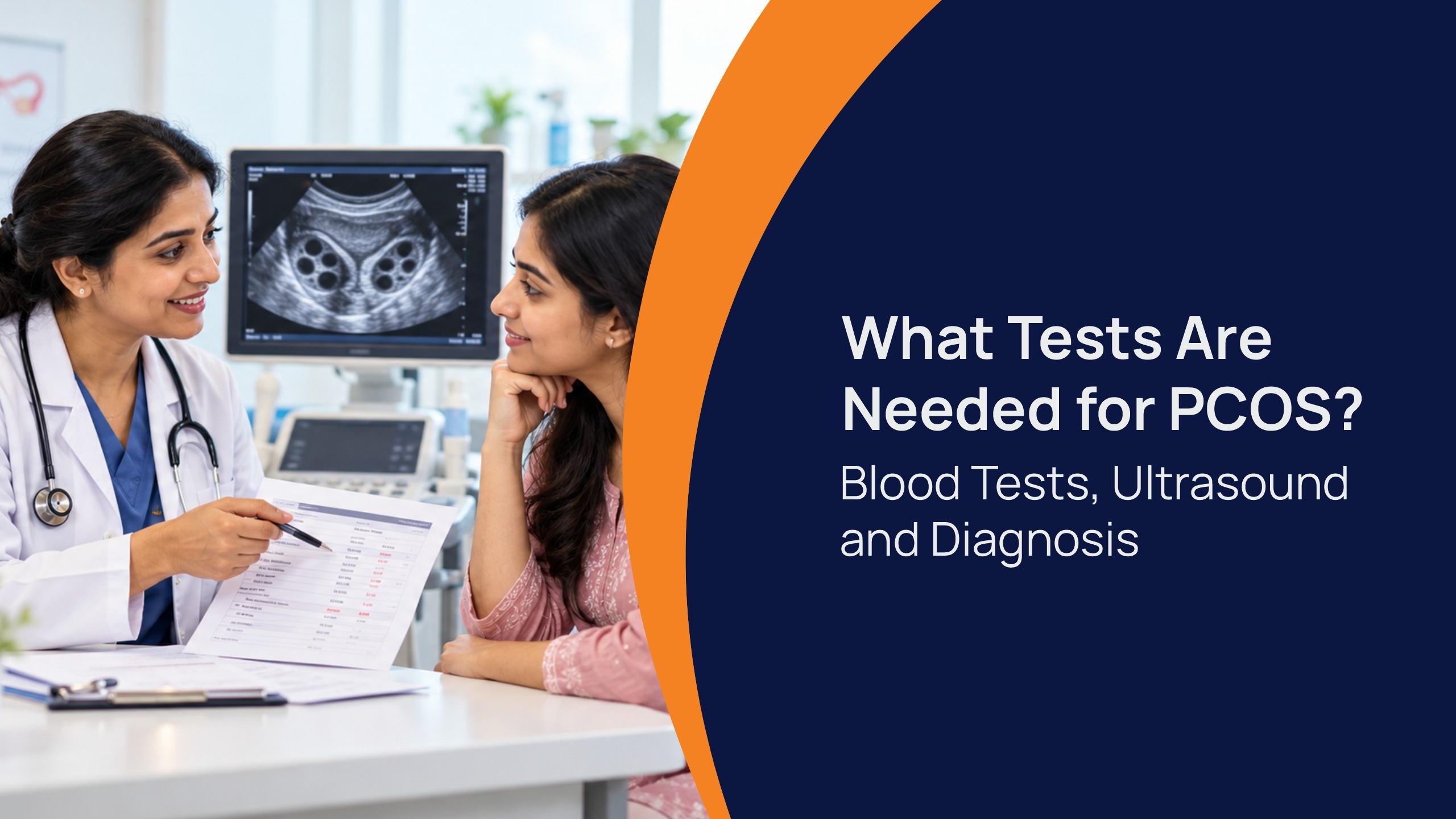
If your doctor suspects polycystic ovary syndrome (PCOS), you may be advised to get PCOS tests such as blood tests or an ultrasound. These tests help check your hormone levels and rule out other conditions that can look similar.
There is no single test that confirms PCOS in every woman. The tests you need depend on your symptoms, age and menstrual history. PCOS was renamed polyendocrine metabolic ovarian syndrome (PMOS) in May 2026. The new name is being adopted gradually, but the tests and diagnostic criteria remain the same.
Which Blood Tests Are Needed for PCOS?
A PCOS blood test checks hormone levels and looks for conditions with similar symptoms. Common hormonal tests for PCOS include:
- Testosterone: Checks for raised androgens (male-type hormones), which can cause acne, excess facial or body hair, or scalp hair thinning.
- TSH: Assesses thyroid function, as thyroid problems can disturb menstrual cycles.
- Prolactin: Checks for high levels that may cause irregular or absent periods.
- DHEAS: May help investigate excess androgen production, especially when testosterone is not clearly raised.
- Other tests: FSH (to check ovarian function) or 17-hydroxyprogesterone (to rule out a rare adrenal condition) may be advised.
Your doctor may also suggest blood sugar and cholesterol tests to check metabolic health. Not everyone needs every test, so investigations are chosen based on your medical history. The pathology and laboratory department provides the blood testing services needed for these investigations.
Is an Ultrasound Necessary to Diagnose PCOS?
A PCOS ultrasound looks at the ovaries and uterus. It may show a polycystic ovarian appearance or other pelvic concerns, and it is part of the radiology and imaging services offered at Terna.
- Polycystic-looking ovaries on a scan do not automatically mean you have PCOS.
- Some adults do not need a scan if irregular cycles and androgen excess are already clear.
- Ultrasound is not recommended to diagnose PCOS in adolescents, within roughly eight years of the first period, because normal development can be misleading.
- Depending on your age and comfort, the doctor may choose an abdominal scan or a transvaginal scan.
Your doctor will decide whether a scan is appropriate.
What Other Tests May Be Recommended?
Some tests assess health concerns linked to PCOS but cannot confirm it on their own:
- Blood sugar tests: Fasting glucose, HbA1c or an oral glucose tolerance test (OGTT). Women with PCOS have a higher risk of prediabetes and type 2 diabetes, and the OGTT is generally the most accurate way to check.
- Lipid profile: Measures cholesterol and triglycerides to assess heart health risk.
Is an AMH Test Required for PCOS?
The anti-Müllerian hormone (AMH) test measures a hormone made by cells in the ovarian follicles. In some adults, it can be used instead of ultrasound to assess polycystic ovarian appearance.
AMH cannot diagnose PCOS on its own and is not recommended for adolescents. AMH and ultrasound are not usually both needed for the same purpose.
How Do Doctors Diagnose PCOS?
PCOS diagnosis involves assessing symptoms and excluding other conditions. In adults, at least two of these three features are generally needed:
- Irregular menstrual cycles or ovulation.
- Clinical or biochemical evidence of androgen excess.
- Polycystic ovarian appearance on ultrasound, or appropriately used AMH testing.
In adolescents, diagnosis requires both persistent menstrual irregularity (judged by the time since the first period) and evidence of androgen excess. Ultrasound and AMH are not advised in this age group.
Irregular periods can have many causes, which is why doctors rule out other conditions first. Although PCOS and PCOD are often used interchangeably, they are not necessarily the same in every context.
How Should You Prepare for PCOS Tests?
PCOS test preparation depends on the tests prescribed. If you are planning tests for PCOS in females:
- Note the dates of your recent periods. Some hormone tests are timed to a particular day of the cycle, so ask your doctor.
- Tell your doctor about medicines, supplements and hormonal contraception.
- Ask whether any test needs fasting, usually 8 to 10 hours for glucose tests.
- Bring previous reports, if available.
- Follow your doctor’s or laboratory’s instructions.
- Do not stop prescribed medicines without medical advice.
Where Can You Get PCOS Testing in Navi Mumbai?
If you have irregular periods, acne or excess facial hair, a gynaecologist can help decide which tests you need. Appointments for PCOS-related concerns can be arranged with the Obstetrics & Gynaecology Department at Terna Speciality Hospital & Research Centre, Nerul, Navi Mumbai.
Final Takeaway
PCOS tests depend on your symptoms, menstrual history and health needs. Blood tests check hormones and metabolic health, while an ultrasound or AMH test may help in some adults. A gynaecologist can tell you which investigations are right for you.
If you are concerned about PCOS, hormonal imbalance or irregular periods, you can book an appointment at Terna Speciality Hospital & Research Centre, Nerul, Navi Mumbai.
Still have lingering questions? Let’s address the most common ones patients ask.
Which blood test confirms PCOS?
No single blood test confirms PCOS. Hormone tests help assess androgen levels and rule out other conditions.
Can PCOS be diagnosed without an ultrasound?
Yes. Some adults can be diagnosed without a scan when irregular cycles and androgen excess are clear and other causes are excluded.
Do I need to fast before a PCOS blood test?
Not every test needs fasting. Tests such as fasting glucose or OGTT usually do, so confirm with your doctor or laboratory.
Can an AMH test confirm PCOS?
No. AMH may help assess ovarian appearance in some adults, but it cannot diagnose PCOS on its own.
Disclaimer: The information provided on this blog is for general educational purposes only and should not be considered a substitute for professional medical advice, diagnosis, or treatment. Always consult a qualified healthcare professional for advice.