
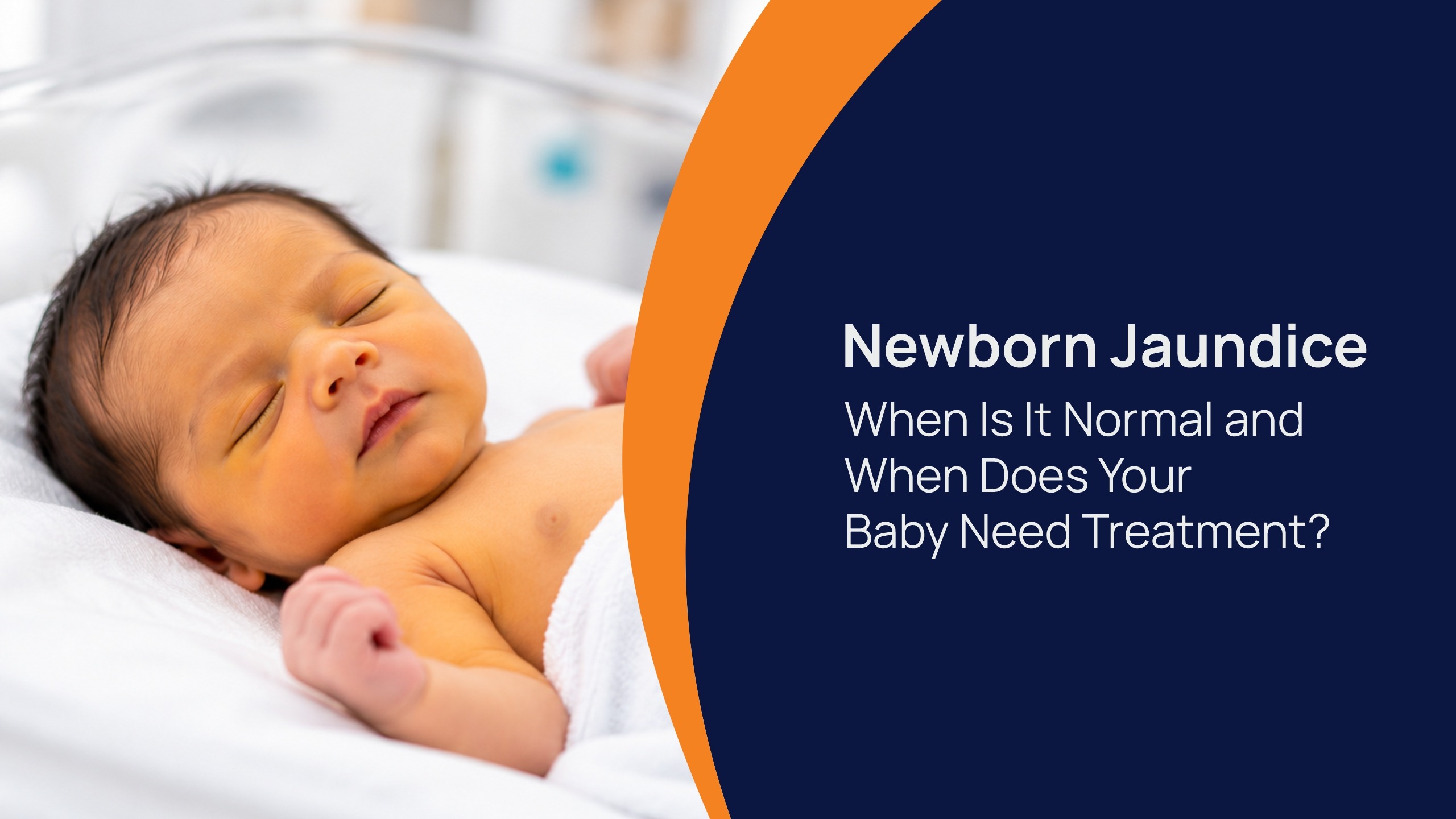
Seeing your newborn’s skin or eyes turn yellow can be worrying, especially for first-time parents. Jaundice in newborn babies is very common in the first few days of life, and many parents go through it. It happens when bilirubin, a yellow substance formed as red blood cells break down, builds up in the baby’s blood. Doctors also call it neonatal jaundice or newborn jaundice.
Most babies recover as their liver matures. However, very high bilirubin levels can be harmful, so it helps to know what to look for and when to seek medical help.
What Causes Newborn Jaundice?
A newborn’s liver needs time to mature before it can clear bilirubin efficiently. Jaundice may also be linked to:
- Premature birth: The baby’s liver may need more time to develop.
- Feeding difficulties: If the baby is not getting enough milk, bilirubin takes longer to leave the body.
- Blood group incompatibility (Rh or ABO mismatch) or G6PD deficiency: These can make red blood cells break down faster.
- Bruising during birth: Bruising can increase bilirubin production.
- Infection: Some newborn infections can also raise bilirubin levels.
- Family history: A brother or sister who needed phototherapy for jaundice can mean a higher risk for your baby.
Physiological vs Pathological Jaundice
Not all jaundice is the same.
- Physiological jaundice is the common, expected kind. It appears after the first 24 hours, peaks around days 3 to 5 in full-term babies, and fades as the liver matures.
- Pathological jaundice is jaundice that needs medical attention. It may appear within the first 24 hours, rise quickly, reach a high level, or last longer than expected. It is usually linked to an underlying cause, such as blood group incompatibility or infection.
You cannot tell the difference by looking at your baby. Only a doctor’s assessment and a bilirubin test can do that.
What Are the Common Newborn Jaundice Symptoms?
The most noticeable newborn jaundice symptoms are yellow skin and yellowing of the whites of the eyes. The colour usually starts on the face and may spread to the chest, tummy, arms and legs.
How to check at home: Look at your baby in bright natural light. Gently press a finger on the nose or forehead and release. If the skin looks yellow when you press it, it may be jaundice. Yellowing can be harder to see on darker skin, so also check the whites of the eyes and the gums. Do not rely only on how yellow the baby looks. The colour does not tell you how high the bilirubin is.
Timeline to know:
- Jaundice commonly appears after the first 24 hours.
- It often peaks around days 3 to 5 in full-term babies.
- In premature babies, it often peaks later (around days 5 to 7) and can last longer.
- It usually improves over one to two weeks in full-term babies.
Breastfeeding Jaundice and Breast Milk Jaundice
Parents often worry that breastfeeding is causing the jaundice. There are two terms to know:
- Breastfeeding jaundice can happen in the first week when the baby is not getting enough milk yet. Better latching, more frequent feeds and support from a lactation expert usually help.
- Breast milk jaundice can appear after the first week and may last longer. The baby is usually healthy and feeding well. Your doctor should still examine your baby and check bilirubin to confirm the cause.
In most cases, breastfeeding should continue. Always follow your paediatrician’s advice.
When Is Jaundice in Newborn Babies a Concern?
Contact your paediatrician promptly if you notice yellow skin or eyes in your baby. Jaundice in the first 24 hours needs urgent medical assessment. Seek prompt advice if the yellowing becomes more noticeable or comes with:
- Poor feeding, or too few wet diapers (nappies). By day 5 to 6, most babies have at least 6 wet diapers a day. Breastfed newborns generally feed 8 to 12 times in 24 hours in the early days.
- Dark urine or pale, white or grey stools.
- Yellowing that continues beyond two weeks in a full-term baby or three weeks in a premature baby.
Seek emergency care if your baby is difficult to wake, unusually floppy or stiff, arches the back, has a high-pitched cry, develops jerking movements or has trouble breathing. Do not wait for a routine appointment if these signs appear.
How Are Bilirubin Levels in Newborns Checked?
Your doctor will examine your baby and may recommend a bilirubin test:
- Skin test: A handheld device estimates bilirubin without drawing blood.
- Blood test: A blood sample measures bilirubin directly.
There is no single normal bilirubin level in newborns. The safe range depends on the baby’s age in hours, gestational age and other risk factors, so doctors compare each result against these factors. The results help the doctor decide whether your baby needs monitoring or treatment.
When a bilirubin blood test is needed, the sample is processed in our hospital laboratory.. If your baby is discharged within 48 hours of birth, ask your doctor when the first jaundice check should be scheduled.
What Is the Treatment for Newborn Jaundice?
The right newborn jaundice treatment depends on your baby’s bilirubin level, age and overall health.
- Feeding support: Regular, effective feeding helps the body pass bilirubin through stools. Breastfeeding can usually continue.
- Phototherapy for newborn jaundice: Special medical lights help the body break down bilirubin so it can be eliminated. During treatment, the baby is usually undressed to expose more skin, with the eyes protected. The care team monitors bilirubin levels and the baby’s overall condition.
- Additional treatment: If an underlying condition is causing jaundice, it needs specific treatment. Rarely, severe cases may require an exchange transfusion.
Avoid home remedies. Do not place your baby in direct sunlight (dhoop), and do not give water, honey, ghutti, gripe water or herbal drops. They do not treat jaundice, can be unsafe for newborns and may delay proper care. Follow your paediatrician’s advice on feeding, testing and follow-up visits.
Newborn Jaundice Care at Terna Hospital, Nerul, Navi Mumbai
If you are worried about your baby, timely medical advice can help you understand the next steps. A paediatric assessment can help determine whether your baby needs bilirubin testing, monitoring or treatment.
At Terna Speciality Hospital & Research Centre, opposite Nerul Railway Station, our Paediatrics team can assess your baby and guide you on appropriate care. For newborns who need close monitoring or specialised care, we have a Neonatal Intensive Care Unit (NICU)
Looking for a pediatrician in Nerul or Navi Mumbai? Make an enquiry at Terna Speciality Hospital.
Still have lingering questions? Let’s address the most common ones patients ask.
Is jaundice normal in newborns?
Jaundice is common and often improves as the liver matures. However, jaundice in the first 24 hours or worsening yellowing needs prompt medical assessment.
How long does jaundice last in newborns?
It usually improves over one to two weeks in full-term babies. If it continues beyond two weeks in a full-term baby or three weeks in a premature baby, a paediatrician (pediatrician) should assess it.
Can I continue breastfeeding if my baby has jaundice?
Usually, yes. If your baby feeds poorly or is not getting enough milk, ask your doctor or a lactation expert for support.
What is a normal bilirubin level in newborns?
There is no single number. The acceptable level depends on your baby’s age in hours, gestational age and risk factors. Your doctor will interpret the result for your baby.
Is sunlight good for newborn jaundice?
No. Direct sunlight does not treat jaundice safely and may delay proper care. Medical phototherapy is given under supervision when needed.
Disclaimer: The information provided on this blog is for general educational purposes only and should not be considered a substitute for professional medical advice, diagnosis, or treatment. Always consult a qualified healthcare professional for advice.