
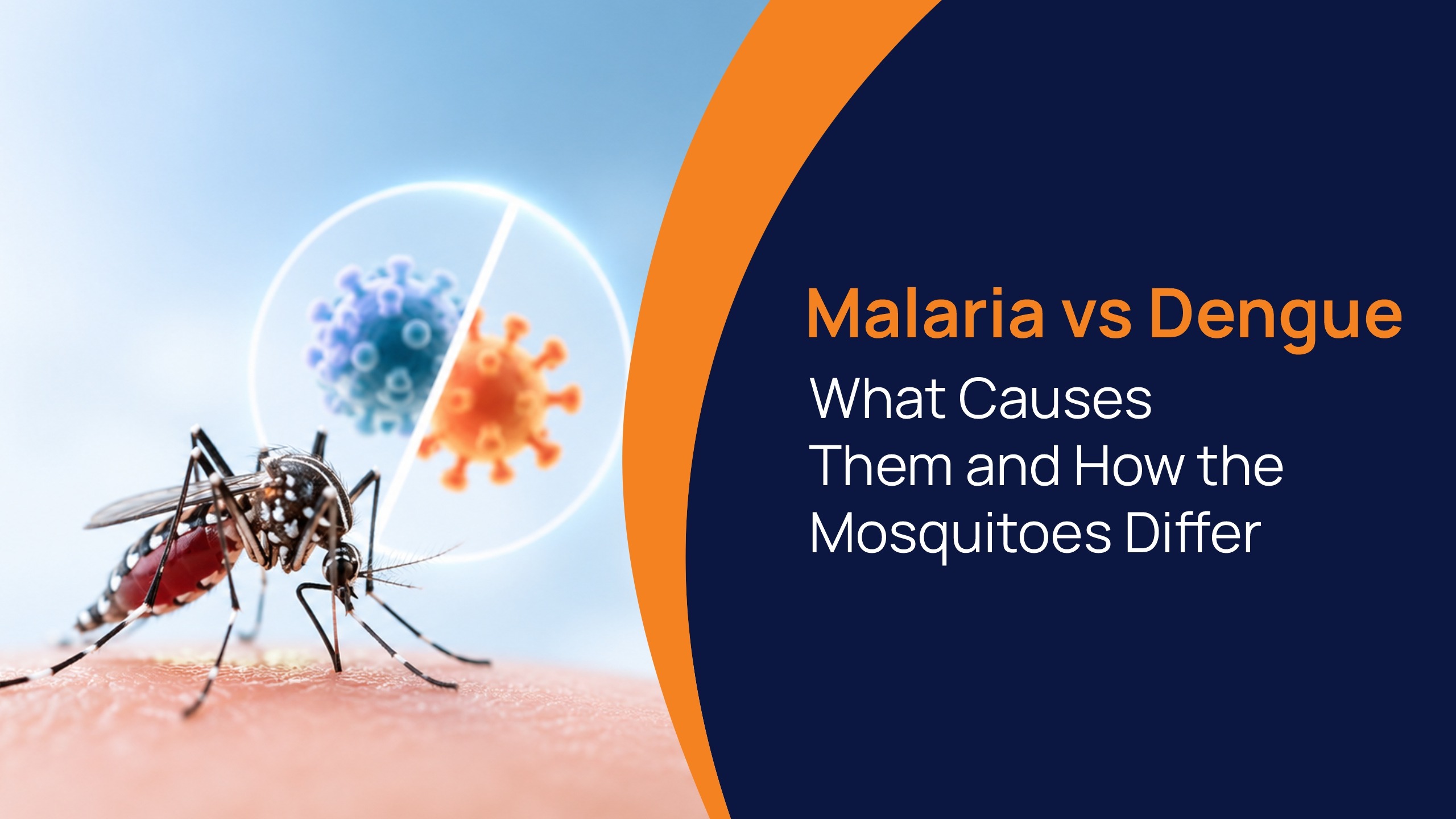
Malaria and dengue get confused constantly, and it’s easy to see why. Both start with fever, body ache, and a mosquito bite nobody remembers getting. But the two illnesses come from different organisms, spread through different mosquitoes, and need different treatment once diagnosed.
What Causes Malaria?
Malaria comes from a parasite, not a virus. Five species of Plasmodium can infect humans. P. falciparum and P. vivax cause most cases, and P. falciparum is the one responsible for severe, life-threatening malaria. The parasite enters the bloodstream when an infected female Anopheles mosquito bites, travels to the liver, multiplies there, then moves into red blood cells. That cycle is why malaria fever often comes in waves rather than staying constant.
WHO recorded 282 million malaria cases and 610,000 deaths worldwide in 2024, with about 95% of both concentrated in Africa. It isn’t only an African disease, though. India still reports cases every monsoon fever season, with states like Odisha and Chhattisgarh carrying a disproportionate share of the burden.
What Causes Dengue?
Dengue is viral. Four related but distinct strains, DENV-1 through DENV-4, cause it, and getting infected with one doesn’t protect against the others. A second infection with a different serotype actually raises the risk of severe dengue, which is part of why repeat infections worry doctors more than a first one.
The virus spreads through Aedes aegypti mosquitoes, with Aedes albopictus playing a smaller role. 2024 was dengue’s worst recorded year: WHO logged more than 14.6 million cases and over 12,000 deaths across more than 100 countries.
Anopheles vs Aedes: The Mosquitoes Aren’t the Same
| Anopheles (malaria) | Aedes aegypti (dengue) | |
| Bites | Dusk to dawn | Daytime, especially early morning and late afternoon |
| Breeding site | Stagnant freshwater: ponds, puddles, rice fields | Clean stored water: coolers, flowerpots, tyres, tanks |
| Resting posture | Body angled upward | Body flat against the surface |
| Markings | Speckled wings | Black-and-white striped legs |
This difference is why malaria prevention leans on bed nets and indoor spraying, while dengue prevention is mostly about clearing standing water around the house.
How Transmission Actually Works
Neither disease spreads person to person through casual contact. A mosquito has to bite an infected person, then bite someone else after the pathogen has incubated inside it: roughly 10 to 18 days for the malaria parasite, 8 to 12 days for dengue virus. That gap is why stopping mosquito breeding during outbreak season can break the chain before it spreads further.
Symptoms Worth Telling Apart
Malaria fever classically cycles: chills, then high fever, then sweating, repeating every 48 to 72 hours depending on the species. Dengue tends to hit harder and faster, with a severe headache, pain behind the eyes, and joint pain intense enough that dengue earned the nickname “breakbone fever.” Only a blood test can confirm which one a patient actually has, so self-diagnosis based on symptoms alone isn’t reliable.
Prevention That Actually Works
- Sleep under insecticide-treated nets in malaria-endemic areas
- Empty or cover water storage containers weekly to stop Aedes breeding
- Use repellent during the day for dengue and at night for malaria
- Screen windows and doors
- See a doctor within 24 hours ofonset after time spent in an endemic area
Visit the best internal medicine specialist at Terna Hospital, Navi Mumbai. Enquire now and consult our specialists.
Still have lingering questions? Let’s address the most common ones patients ask.
Can you get malaria and dengue at the same time?
Yes, though it’s uncommon. Co-infection has been documented in regions where both Anopheles and Aedes mosquitoes are active. The symptom overlap means diagnosis needs separate blood tests for each disease.
Which is more dangerous, malaria or dengue?
Both can be fatal without treatment. Malaria kills more people globally each year, largely due to under-5 mortality in Africa. Dengue’s danger is its unpredictability: a mild first infection can be followed by a severe second one.
Does the same mosquito spread both diseases?
No. Anopheles spreads malaria, and Aedes spreads dengue. They look different, bite at different times, and breed in different water, which is why prevention for each disease looks different too.
How soon should I see a doctor after a mosquito bite?
Not after every bite. But if fever, chills, or body ache start within two weeks of being in a malaria or dengue-affected area, get tested promptly. Early treatment lowers the risk of complications for both diseases.
Disclaimer: The information provided on this blog is for general educational purposes only and should not be considered a substitute for professional medical advice, diagnosis, or treatment. Always consult a qualified healthcare professional for advice.